Related Posts
Join our pack and get expert advice, clinic updates, and pet wellness tips delivered straight to your inbox.

This article reviews current research on compounded pimobendan, explores potential risks related to stability and absorption, and summarizes key findings on dissolution and bioavailability to help veterinary teams make informed, patient-focused decisions.

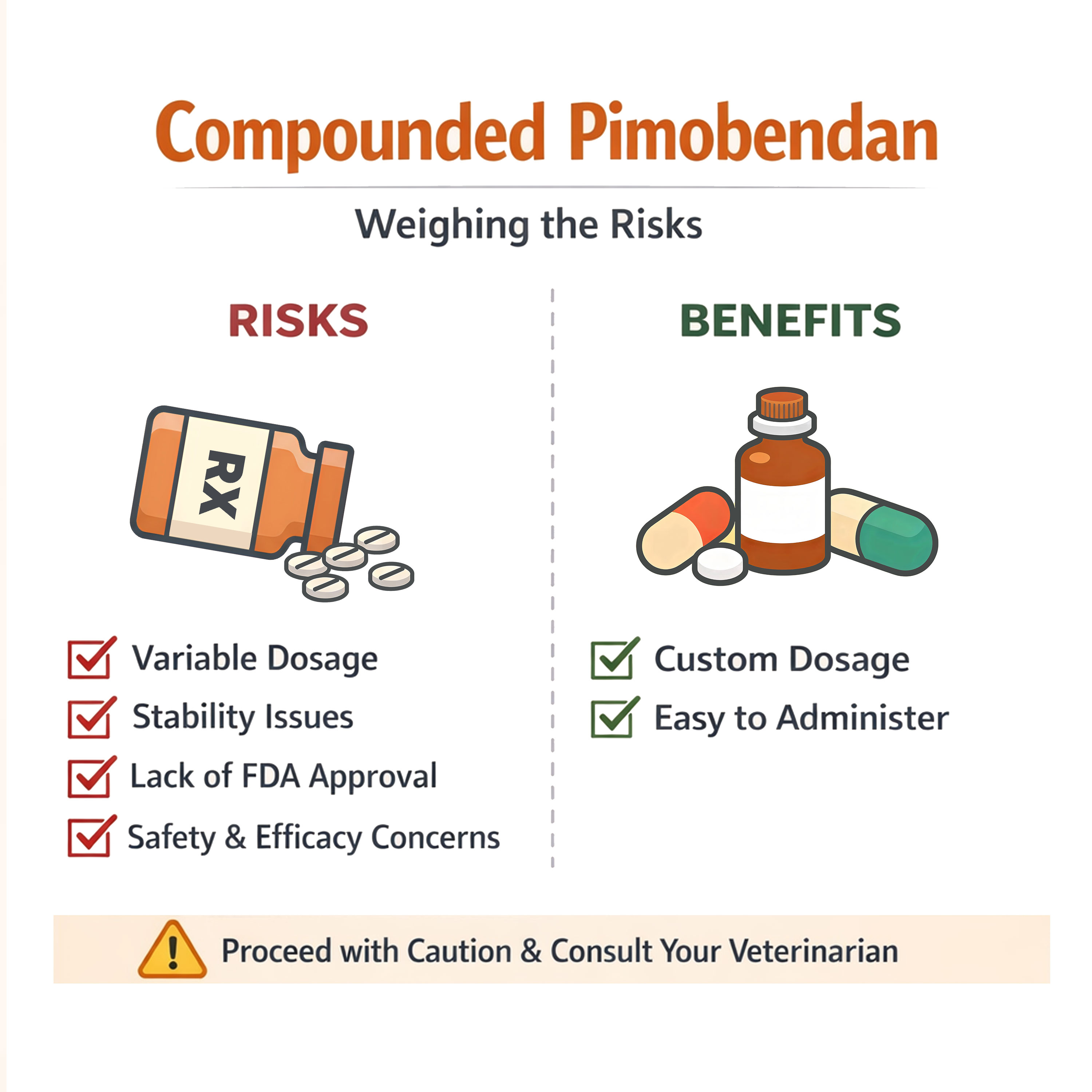
All compounded products come with a set of risks:
Choosing a high-quality compounding pharmacy can decrease these risks, and using a 503b outsourcing facility addresses the first three risks, but the risk that the compounded product may lack safety and/or efficacy still remains since these aren’t FDA approved products. However, despite these risks, we frequently encounter situations where a compounded product is a better option for our patients than an FDA-approved product. This may be due to flavor, formulation, dosage, or a backorder of the approved product. However, cost alone is never a suitable reason for choosing to use a compounded product over an approved one.
While the risks above are inherent to compounds in general, there are some drugs that we know are problematic when compounded such as itraconazole. One product that frequently comes up in discussion regarding efficacy of compounded dosage forms is pimobendan. Does the compounded product work as well as the FDA-approved product? This question came to light several years ago when compounded options were the only option to obtain pimobendan in the United States due to manufacturer backorders. Those backorders have since resolved, but some found that the small, compounded tablets were easier to administer and split than the larger FDA-approved chewable tablets keeping the efficacy question relevant despite stable stock levels.
The Pimobendan Situation
While some drugs have clear, easy to interpret markers of efficacy such as total T4 level for methimazole, pimobendan isn’t quite as easy to study. However, two studies have attempted to take this on using different surrogate markers for efficacy.
For pimobendan, the efficacy concern is related to absorption of the compounded product. If the drug isn’t absorbed, then it can’t exert its effect. Therefore, both studies looked at end points related to absorption to make a conclusion about likely efficacy.
The First Study – Dissolution
The first study we will look at is an internal study completed by Boehringer-Ingelheim (BI). This study looked at the dissolution of compounded pimobendan from four compounding pharmacies compared to the FDA-approved chewable tablet.
Dissolution is relevant to the discussion about absorption because for a product to be absorbed, it must first dissolve. If the product isn’t dissolving at a physiological pH, then it won’t get absorbed. This same type of analysis was used in a 2012 study on FDA-approved Trilostane® compared to compounded products.
BI’s study had the followed observations:
The author’s concluded “compounded pimobendan can behave pharmacologically differently from the first step in the PK process, depending on which compounding pharmacy produced the drug, and the pH level of the stomach environment for a particular dog. Variation from batch to batch can also occur.”
The full report and results can be viewed here.
The Second Study – Bioavailability
The second study we will look at was completed at the University of Georgia College of Veterinary Medicine and recently published in the Journal of Veterinary Cardiology. This study looked at the bioavailability of FDA-approved pimobendan, compounded capsules containing citrate and compounded capsules without citrate. The study measured the peak plasma concentrations and areas under the concentration-time curve (AUCs) for seven healthy adult female purpose-bred beagle dogs after administering 2.5 mg of pimobendan.
This study did not identify any statistical differences in bioavailability between the tested formulations. However, this was not designed to confirm bioequivalence. The study did note that there was significant pharmacokinetic variability between patients for all formulations.
The full study can be viewed here.
Clinical Impact
These studies were both done in an attempt to answer the question, “Does compounded pimobendan work as well as the FDA-approved product?”. While both provide relevant perspectives, neither gives a definitive answer, and that is the nature of compounding. Different compounding pharmacies may prepare the same drug and dosage form using different formulations which may or may not impact the efficacy.
We can make the following conclusions based on the data presented in these studies:
- Pimobendan formulations from different pharmacies or even different lots from the same pharmacy may work differently. (Note: This is likely true for all compounded products.)
- Compounded pimobendan has the potential to be absorbed in capsule form.
- There is interpatient variability in pimobendan pharmacokinetics regardless of formulation.
Conclusions and Action Steps
These studies provide an illustration of why FDA-approved products should be used when possible. Pimobendan has variability between patients in any form, and this is accounted for during FDA-approval with the size of the studies. However, this variability has not been accounted for in compounded product efficacy. However, when there is a legitimate need for a compounded product such as a backorder or a patient that can’t be medicated with the large chewable tablets, then a compounded product may potentially be an option. It’s important though to use caution when selecting where to obtain the compounded product since there will be variability between pharmacies.


Join our pack and get expert advice, clinic updates, and pet wellness tips delivered straight to your inbox.