Related Posts
Join our pack and get expert advice, clinic updates, and pet wellness tips delivered straight to your inbox.

This article explains when and why veterinary medications can or cannot be split, crushed, or opened to ensure safe and effective administration to animal patients.

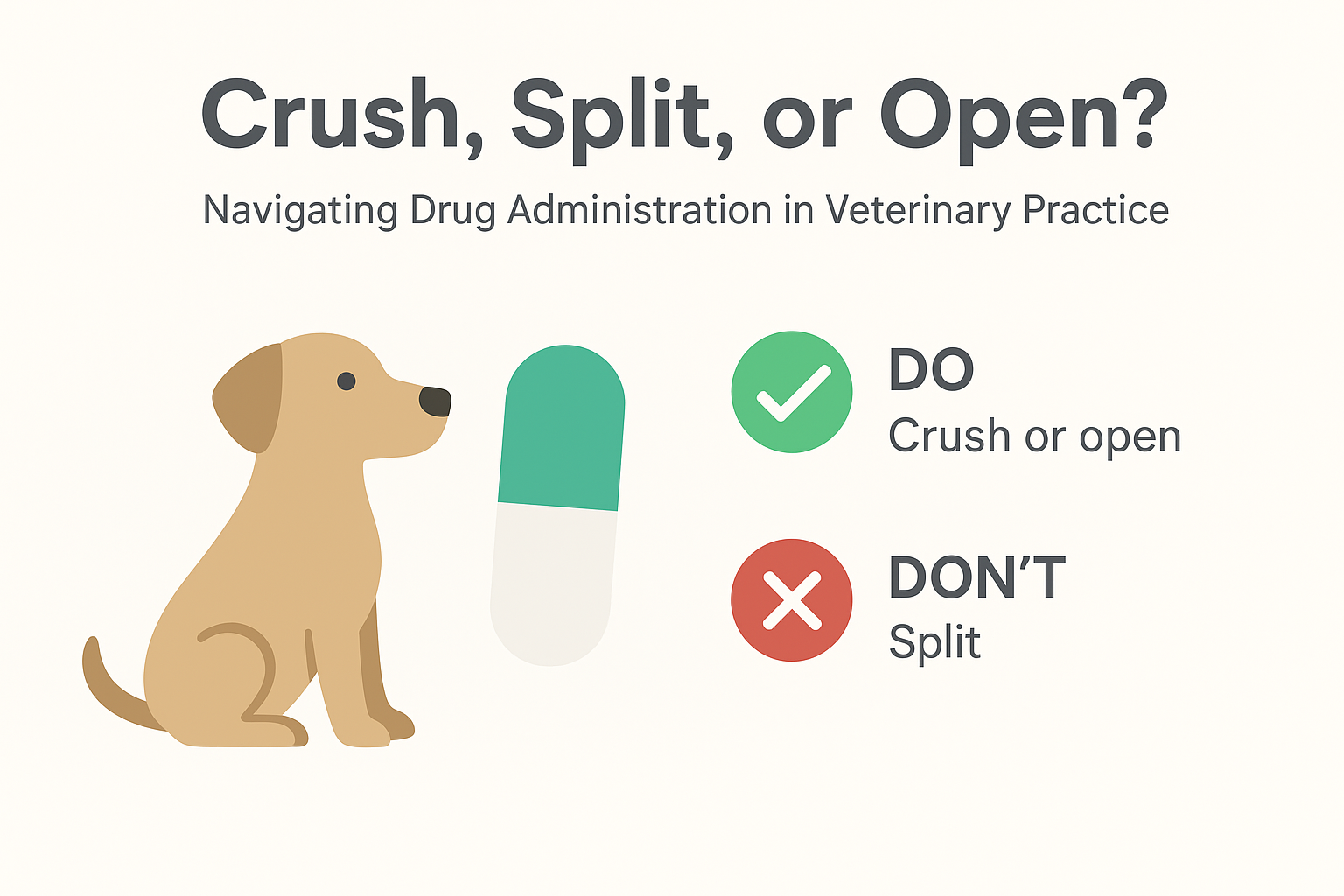
So many medications come as tablets or capsules, but often times our animal patients aren’t big fans of taking these dosage forms. That leaves us questioning how to advise clients on getting the medication into our patient consistently. It can be appealing to tell clients to open the capsule or crush the tablet and then mix it into the food or a tasty liquid. But is this really a good idea? Well it depends on…
1. Drug release mechanisms
2. Taste
3. Stability
4. Drug distribution in the dosage form
Sometimes solid oral dosage forms are designed to dissolve quickly and entirely when they enter the stomach. However, others are designed to dissolve slowly so the drug is released at a steady rate over a period of time. When drugs need to be released slowly, this can be accomplished by using a capsule or tablet coating that slows the release or by formulating the entire drug mixture to dissolve slowly.
When drugs are designed to dissolve slowly, they are generally indicated with something in the name. This could be SR (sustained release), ER (extended release) CR, (continuous release), or DR (delayed release). These drugs warrant extra investigation/caution when considering if they should be split. Crushing or splitting a drug that utilizes a coating for extended release can cause the entire amount to be released immediately resulting in side effects or overdose.
Some drugs are really bitter, and in those cases, capsules or tablet coatings can be used to mask the bitter flavor which can work to our benefit assuming the animal does not bite down into the medication. Sometimes these tablets may even have a sweat flavor to the coating since combining sweet and bitter flavors decreases the perception of both.
From a safety standpoint, there isn’t a concern with splitting tablets that are coated for flavor purposes. However, for drugs that are bitter, it may do more harm than good from an ease-of-administration standpoint.
Some drugs are formulated to aid in drug stability. For example, a tablet may be coated to help decrease water absorption by a drug prone to this. In these cases, splitting/crushing tablets or opening capsules immediately prior to administration isn’t usually an issue. However, splitting/crushing/opening ahead of time may result in drug stability issues and isn’t recommended.
When tablets are created with labeled dosing that requires splitting a tablet, then the drug company must prove the drug is evenly distributed between the splitting segments. If a drug label doesn’t indicate splitting, then that isn’t required. However, that may not be sufficient reason to say the drug isn’t evenly distributed.
When considering that tablets are manufactured in large lots from a large batch of the tablet mixture being pressed into the appropriate mold, that mixture must be uniform, and the drug company must prove that each tablet as a whole contains the appropriate amount of drug. Therefore, it stands to reason, that even if not labeled for splitting, the drug is probably distributed pretty evenly throughout the tablet. The question then becomes; can it reliably be split into even parts. Regardless of who is splitting the tablet, it may not end up being exactly equal. However, some tablet shapes are easier to split than others. Also, if there are lines to indicate halves or quarters, then that makes it much easier to split evenly.
A list of drugs that should not be split/crushed can be found at https://www.empr.com/charts/do-not-crush-or-chew/. However, this is a human drug list, so veterinary products aren’t considered for inclusion. There are also things on this list that we may still split for veterinary patients.
Other methods to determine if something can be split/crushed include the following:
- Immediate versus delayed release considerations – if some type of modified release, then additional investigation is warranted.
- Dosing recommendations in common references – if the reference includes doses that use split tablets and no warning about not splitting tablets, then likely okay.
- If it’s a chewable tablet, then splitting/crushing is fine.
What About Compounding?
Compounded liquids can be a helpful dosage form to get drugs into challenging patients. Compounding formulations take into consideration the factors in this article along with several others when considering if the compound should be made by manipulating commercially available dosage forms or using bulk chemical. There are also other ingredients included in compounds designed to enhance formulation stability for storage over several days or weeks. Therefore, drugs that may not be appropriate for a client to crush and mix with a liquid at home for administration, could potentially be compounded into a liquid formulation by a high-quality compounding pharmacy.
Determining if we can split/crush/open tablets and capsules for veterinary patients isn’t an exact science. However, understanding the reasons why some things shouldn’t be modified can help with making a decision. However, when deciding to go ahead with modifying the dosage form for administration, err on the side of caution and split/crush/open it immediately prior to administration, not in advance.
✅ Don’t guess — click here to get personalized advice from our veterinary pharmacy expert.


Join our pack and get expert advice, clinic updates, and pet wellness tips delivered straight to your inbox.